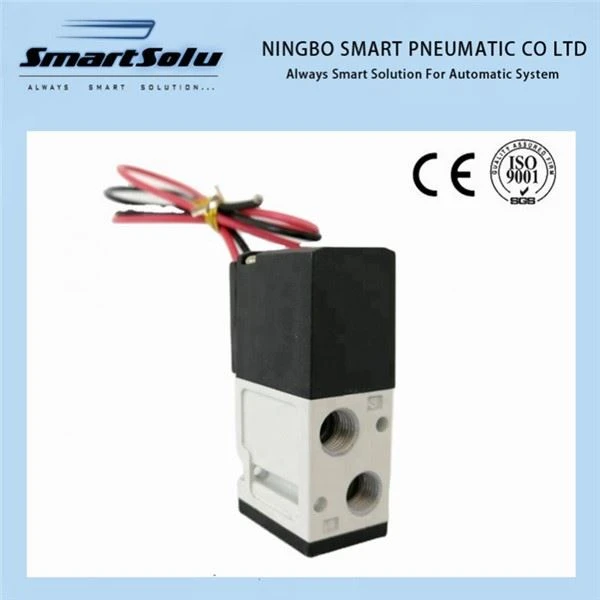
Directional Solenoid Valve

Your Leading Directional Solenoid Valve Supplier


Smart Pneumatic Solutions was established in 2013, specializing in providing high-performance intelligent pneumatic equipment and solutions for the industrial automation sector. We are committed to advancing the intelligent transformation of pneumatic systems through innovative technologies, serving industries including automation, commercial vehicles, medical devices, and the food and beverage sector. After 10 years hard working, Smart Pneumatic Co., Ltd owed 2 factories now, and our products are including pneumatic vibrators, air cylinders, solenoid valves, fittings, and other accessory, and are exported to 98 countries and regions, covering key industrial markets such as North America, Europe, and Southeast Asia.


First 123456 Last 1/6

 
Why Choose Us?

Quality control

Our products have obtained ISO 9001:2015 Quality Management System certification along with CE and UL international safety certifications,

Custom service

Supported by a dedicated R&D team of experienced engineers, we deliver tailored solutions to meet your customized requirements.

High quality

Every unit undergoes 200% pressure testing, AI-simulated operational scenario verification, and full lifecycle tracking to ensure zero-defect delivery.

24H online service

Providing end-to-end services from design consultation to post-sales support, with <24-hour response time and a 99.8% customer satisfaction rate.


Types of Directional Solenoid Valve

Direct acting solenoid valve

Direct acting is a term generally associated with diaphragm solenoid valves or solenoid poppet valves. It means that by energising the solenoid coil, there is a direct influence on the position of the solenoid valve. For instance, if the valve is closed in its resting position, then energising the solenoid coil in a direct-acting solenoid valve will move the diaphragm into its open position.


Indirect-acting (pilot operated) solenoid valve

Indirect-acting Solenoid Valves, also known as ‘pilot operated solenoid valves,’ are generally always of the diaphragm style solenoid valve type. The ‘pilot operated’ term refers to the media acting as a pilot to assist with the operation of the valve. Normally, there is a small orifice in the inlet port of the solenoid valve that allows some of the media to enter into a cavity on top of the diaphragm. In a normally closed valve, the media then applies pressure to the top of the diaphragm, holding it in the closed position. When the solenoid coil is energised, the diaphragm opens and the media is forced out of the top cavity and back into the main pressure line.


Normally closed or normally open

These terms refer to the resting state of the valve, with no power applied. Although they are fairly self-explanatory, they can also be referred to using different terms. A normally closed solenoid valve can be described as ‘energise to open,’ and a normally open solenoid valve can be described as ‘energise to close.’ Normally closed or normally open most commonly refer to diaphragm or poppet-type solenoid valves that employ a spring to return the valve to its resting state once the power has been removed from the coil.


2/2-way (on-off)

2/2-Way Solenoid Valves are generally diaphragm or poppet type valves, and can only be used for On/Off duty as there is no exhaust port. They are very versatile and can be deployed in a wide variety of applications in many different industries to simply switch flow on and off. In some instances, it is possible to have a 2/2-Way Proportional Solenoid Valve which is used to regulate flow.


3/2-way (sol/spring)

The term 3/2-Way is most commonly associated with a spool-type solenoid valve, although it is possible to have a poppet-type valve in this configuration. The term 3/2 can be extruded to mean ‘3 port, 2 position.’ This same formula can be applied to other valve types with a similar abbreviation. In their resting state, the most basic of 3/2-Way valves uses port 1 as the valve inlet, port 2 as the outlet and port 3 as the exhaust but is blocked in its resting state. When power is applied via the solenoid, the spool position changes and port 1 becomes blocked, with port 2 flowing to port 3 and therefore exhausting the system. When power is removed, the spool springs back to its resting position and normal valve function is restored. This is why the operation of this type of 3/2-Way Spool Valve is also known as ‘Sol/Spring.’ 3/2-Way Spool Valves are most commonly used as a pilot to a Single Acting Pneumatic Actuator or Pneumatic Cylinder.


5/2-way (sol/spring or sol/sol)

A 5/2-Way valve is also most commonly supplied as a spool type of solenoid valve. They operate in much the same way as a 3/2-Way Valve, but there are two extra ports which can be used to pilot double-acting pneumatic actuators or pneumatic cylinders. They can be supplied with a single coil allowing spring return (known as Sol/Spring), or with a double solenoid coil (known as Sol/Sol).


5/3-way (sol/sol – apb or pressure held)

5/3-Way Solenoid Valves are most commonly supplied with two coils. They are always of the spool valve type and have 5 ports and 3 positions. Two of the positions perform the same function as those found in a 5/2-Way solenoid valve type, and the third position performs an additional operation. The third position is normally engaged by spring and is activated when no power is applied to either solenoid coil. The most common function the third position performs is a Pressure-held function, sometimes referred to as ‘all ports blocked.’ This holds the valve and the larger actuator/instrument in a steady state until power is applied to one of the solenoid coils.


Application of Directional Solenoid Valve
Pneumatic Air Gun
Stainless Steel Branch Multiple Quick Coupling
Air Control Pressure Switch
2/6 Way Stainless Steel Pilot Solenoid Valve

Fire suppression systems

Fire suppression systems depend on solenoid valves to control water or other extinguishing agents. These valves activate during fire emergencies to release the suppressant, helping to contain and extinguish the fire. The reliability and quick response time of solenoid valves make them essential components in fire safety systems.


Water purification and treatment systems

Water purification and treatment systems rely on solenoid valves to manage water flow through various treatment stages. These valves ensure water moves efficiently through filtration, disinfection, and distribution processes. Solenoid valves produce clean, safe water for consumption and industrial use by controlling the flow.


HVAC systems

Solenoid valves are important in heating, ventilation, and air conditioning (HVAC) systems because they regulate the flow of air, steam, and hot water. The valves maintain optimal temperature and humidity levels to ensure comfort in residential, commercial, and industrial settings. By controlling the flow of heating and cooling agents, the valves support energy efficiency and system performance.


Automotive and aerospace industries

Solenoid valves control fuel delivery in the automotive and aerospace industries. They regulate fuel injection in automobiles, ensuring optimal engine performance and fuel efficiency. In aerospace applications, the valves manage the movement of fuel and other fluids in aircraft systems, contributing to the efficiency of aircraft.


Industrial automation

In industrial automation, solenoid valves control the movement of gases and liquids during manufacturing processes. These valves are essential in assembly lines, packaging systems, and chemical processing plants. Their ability to operate quickly makes them ideal for applications requiring accuracy and repeatability.


Medical and dental equipment

Medical and dental equipment are another common application for solenoid valves. They manage the flow of liquids and gases in devices like anesthesia machines, ventilators, and dental chairs. These valves are critical for ensuring the safe and accurate delivery of medications, oxygen, and other essential fluids, contributing to better patient care and treatment outcomes.


Household appliances

Household appliances like washing machines and dishwashers use solenoid valves to manage water. They control the water intake and drainage cycles, ensuring these appliances operate smoothly. Additionally, the valves detect issues like blockages or leaks. If a problem occurs, the valve shuts off the water supply to prevent further issues. This safety feature protects homes from potential water damage.


Agricultural irrigation systems

Solenoid valves help irrigation systems control the flow of water to crops, making them invaluable in modern farming practices. These valves enable precise water distribution, ensuring crops receive the right amount of water at the right time. This precision helps to conserve water and optimize crop yields.


Automatic faucets and lavatories

Solenoid valves are integral components in automatic faucets and lavatories. When you place your hands under or touch an automatic faucet, the sensors activate the solenoid valve, allowing water to flow. This application eliminates the need for manual operation and reduces contact with potentially contaminated surfaces.


Shipping And Payment


productcate-1-1


FAQ

Q: What is a solenoid valve and how does it function?

A: A solenoid valve is an electromechanical device regulating fluid flow. It uses an electromagnetic actuator (solenoid) and a valve body. The solenoid converts electrical energy into motion, opening or closing the valve for precise on/off flow control.

Q: What are the differences between direct-acting, internally piloted, externally piloted, and semi-direct acting solenoid valves?

A: Direct-acting valves operate by solenoid force alone; internally piloted use fluid pressure; externally piloted require outside pressure sources; and semi-direct acting combine solenoid force with system pressure, enabling versatile performance in various applications.

Q: What are proportional solenoid valves used for?

A: Proportional solenoid valves enable precise, continuous control of flow or pressure, responding to varying electrical inputs. They are vital for applications like automated pneumatic actuators, throttle valves, and systems where exact fluid regulation is critical.

Q: Which materials are important when selecting solenoid valve components?

A: Material selection depends on fluid compatibility and system conditions. Solenoid valve bodies use stainless steel, brass, or plastics; diaphragms are often PTFE, EPDM, or NBR; seals may be PTFE, FKM, NBR, or EPDM; stems and tubes favor corrosion-resistant metals.

Q: How does coil voltage selection impact solenoid valve performance?

A: Coil voltage affects electromagnetic force and operational efficiency. Solenoid valves support both AC and DC voltages; typical DC values are 6, 12, 24, and 240V, while AC values include 24, 120, 240, and 480V at 60Hz. The right voltage enhances responsiveness and longevity.

Q: What key factors should facilities consider when choosing a solenoid valve?

A: Consider actuation type, orifice size, flow coefficient (Cv), connection type, voltage, pressure range, fluid compatibility, certifications, temperature, and environmental requirements. Matching these to your application ensures reliable fluid control and system safety.

We're known as one of the most professional directional solenoid valve manufacturers and suppliers in China. Our factory offers customized directional solenoid valve made in China with low price. Welcome to place an order.

(0/10)

clearall