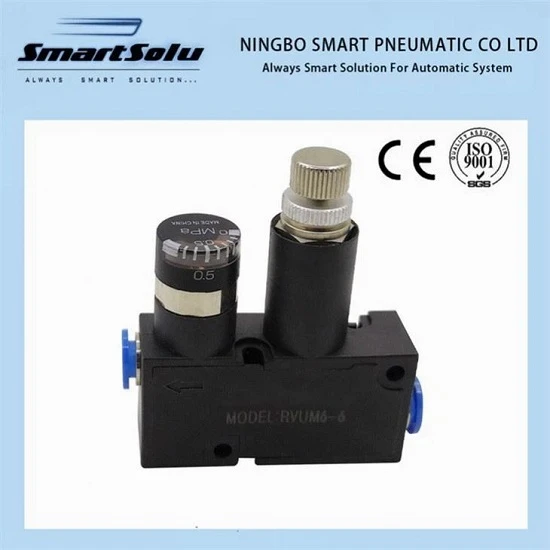
Manually Control Valve

Your Leading Manually Control Valve Supplier


Smart Pneumatic Solutions was established in 2013, specializing in providing high-performance intelligent pneumatic equipment and solutions for the industrial automation sector. We are committed to advancing the intelligent transformation of pneumatic systems through innovative technologies, serving industries including automation, commercial vehicles, medical devices, and the food and beverage sector. After 10 years hard working, Smart Pneumatic Co., Ltd owed 2 factories now, and our products are including pneumatic vibrators, air cylinders, solenoid valves, fittings, and other accessory, and are exported to 98 countries and regions, covering key industrial markets such as North America, Europe, and Southeast Asia.


Why Choose Us?

Quality control

Our products have obtained ISO 9001:2015 Quality Management System certification along with CE and UL international safety certifications,

Custom service

Supported by a dedicated R&D team of experienced engineers, we deliver tailored solutions to meet your customized requirements.

High quality

Every unit undergoes 200% pressure testing, AI-simulated operational scenario verification, and full lifecycle tracking to ensure zero-defect delivery.

24H online service

Providing end-to-end services from design consultation to post-sales support, with <24-hour response time and a 99.8% customer satisfaction rate.


Types of Manually Control Valve
productcate-550-550

Globe valves

Globe valves, characterised by their spherical body, are primarily used for throttling purposes and where precise flow control is needed. The internal mechanism involves a plug or a disc that moves perpendicularly to the seat, which allows for a very accurate control of the flow rate. Their design makes them suitable for applications where flow needs to be finely adjusted, or where the valve must act as both an on/off isolation valve and a control valve. However, the precise control comes at the cost of a higher pressure drop compared to other types of valves.


Ball valves

Ball valves feature a ball with a hole through its center and are known for their durability and reliability, offering tight sealing with minimal pressure drop. They are primarily used for on/off control but can be adapted for throttling purposes with the addition of positioners and actuators. The simplicity in their design makes them suitable for applications involving gases or liquids where a tight seal and long service life are critical. Their operation is quick, usually a 90-degree turn of the handle or actuator to open or close the valve, making them ideal for emergency shut-off applications.

Butterfly valves

Butterfly valves consist of a disc that rotates about an axis inside a body, which allows for quick and efficient flow control. Their compact size and low weight make them an attractive option for space-constrained applications. They can handle a wide range of flow rates and pressures, although they are generally used in lower pressure applications. Butterfly valves are versatile and can be used in various mediums, including water, air, and gases. They are often selected for use in large diameter pipes where a compact valve is needed.


Diaphragm valves

Diaphragm valves use a flexible diaphragm that comes into contact with a seat at the top of the valve body to control flow. The diaphragm acts as both the valve's sealing element and the actuator, eliminating the need for packing glands and reducing the risk of leakage. This design makes them exceptionally suitable for handling corrosive or abrasive fluids, as the wetted parts can be made from or lined with materials resistant to the fluid. Additionally, the tight seal makes them ideal for applications where leakage must be minimised.

productcate-550-550


Manual Control Valve Performance Characteristics:

Improved heating supply:

Branch lines and heating points using manual control valves can adjust flow according to design conditions to achieve optimal temperature operation. This type of valve offers better regulation performance than gate valves and globe valves, exhibiting near-linear regulation. Therefore, uneven heating in various buildings is significantly reduced.

Energy saving:

Temperature and pressure imbalances in the heating network can cause excessive flow in some branches, leading to overheating in some buildings and forcing residents to open windows, thus saving energy.

Improved hydraulic conditions:

Manual control valves can control flow according to rated flow, reducing excessive flow in the network and improving the original deterioration of hydraulic conditions.


Application of Manually Control Valve


Oil and gas

Safety is everything here, making the hand control valve function absolutely critical You willfind them on wellheads for emergency shutdowns and on pipeline block stations to isolate sections for repair. Theyre also the core of a "block and bleed' system, a safety procedure to depressurize equipment before maintenance.


Chemical processing

In a chemical plant. you can't compromise on precision or safety. Manual valves are used to carefully charge reactors with raw materials, where an operator needs to see what's happening. You see them as drain valves on tanks and vessels. And for the plant's utility lines-steam, air, water-the dependable hand control valve

function is used to control supply to different units.


Water and wastewater treatment

These plants depend on manual valves to isolate pumps for maintenance. In chemical dosing systems, small manual needle valves are often used to fine-tune the flow of treatment chemicals. And throughout a city's water distribution grid, large gate valves are there to shut of water to entire neighborhoods during repairs.


Food and beverage

You'llfind stainless steel manual valves used for routing different products, taking samples for quality checks, and on the Clean-in-Place (ClP) systems that wash the pipes between batches. Direct, physical control is what prevents cross-contamination.


Shipping And Payment


productcate-1-1


FAQ

Q: What is a manual control valve?

A: Manual control valves are mainly used in mobile hydraulics, where several functions usually have to be controlled simultaneously. Manual control valves differ significantly from valves used in industrial hydraulics and are characterized by compact design and higher functional integration of the individual segments.

Q: What is the difference between manual valve and control valve?

A: Electronic valves handle a broad range of flow rates and pressures. They can adjust for variations in system conditions. Manual valves need more human intervention. Electronic control valves integrate with automated systems, allowing for remote control and monitoring.

Q: What is the function of manual valve?

A: Manual valves serve three major functions in fluid-handling systems: stopping and starting flow, controlling flow rate, and diverting flow. Valves for stopping and starting flow are frequently employed also for controlling flow rate, and vice versa, while valves for diverting flow are designed for that single purpose.

Q: What is the main purpose of a control valve?

A: A control valve is a power-operated used to regulate or manipulate the flow of fluids, such as gas, oil, water, and steam. It is a critical part of a control loop and is an example of a final control element.

Q: Should control valves always be open or closed?

A: In most cases, control valves should ideally be in a fully open or fully closed position when not actively modulating flow. This ensures that they are either allowing maximum fluid passage or completely blocking it off—both scenarios prevent wear and tear on the valve components over time.

Q: What is the difference between manual and automatic valves?

A: Manual actuation of a valve involves direct, physical contact with its hand wheel, lever or gear operator, while power automated actuation utilizes air pressure, electricity, or hydraulic pressure controlled by flow conditions, monitoring systems, or other means that does not involve physical contact with the valve.

We're known as one of the most professional manually control valve manufacturers and suppliers in China. Our factory offers customized manually control valve made in China with low price. Welcome to place an order.

(0/10)

clearall