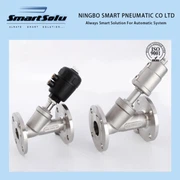
Difference between pneumatic ball valve and pneumatic angle seat valve
Mar 06, 2020
The pneumatic ball valve can be closed tightly only by the operation of turning 90 degrees with the air source of the pneumatic actuator and a small turning torque. The completely equal inner cavity of the valve body provides a small resistance and straight passage for the medium. It is generally believed that the ball valve is the most suitable for opening and closing directly, but in recent development, the ball valve has been designed to throttle and control the flow. The main features of ball valve are compact structure, easy operation and maintenance, suitable for general working media such as water, solvent, acid and natural gas, and also suitable for media with poor working conditions, such as oxygen, hydrogen peroxide, methane and ethylene. The ball valve body can be integral or combined.
Pneumatic angle seat valve has large flow, small flow resistance and waterless hammer Y-shaped design, which enlarges the flow section of the valve chamber, makes the fluid in the valve chamber more smooth and improves the flow by 30%. It is widely used in food and chemical processes, sterilizers, high-pressure sterilizers, dry cleaners, clothes dryers, beer production lines, etc.
Features of pneumatic ball valve:
1. The valve is unblocked or blocked by rotating the valve element.
2. Pneumatic ball valve is light and small in size.
3. It can be made into a large caliber.
4. Reliable sealing, simple structure and convenient maintenance.
5. The sealing surface and the spherical surface are usually closed, which is not easy to be eroded by the medium.
Features of pneumatic angle seat valve:
1. Visual position indication: it can be connected with limit switch or emergency manual device.
2. Easy to install: pneumatic head can rotate 360 degrees. One or two limit switches can be easily installed. 3. Pneumatic controller: thickened engineering plastic shell, safe and reliable. Low wear piston structure, large capacity and low consumption. Internal components self-lubricating, maintenance free.
4. There are many control modes: normally open, normally closed, double acting.
5. Smaller pneumatic actuator required: smaller control head can be selected when the fluid flows from above the valve stem.
6. Easy to connect: mamur standard connection, embedded metal joint.
7. Long life guide rod: stem wedge Teflon (PTEE) seal to avoid the introduction of dirt. Self lubrication, maintenance free. The valve stem is specially treated to ensure that it is fixed and the position can be adjusted automatically.
8. There is no water hammer effect, when the fluid flows from the bottom of the valve stem, the water hammer (water impact force) is absorbed.
9. Valve body mechanism: the flow rate is 30% larger than the common angle seat, the volume is smaller, and the fluid flow state is better.