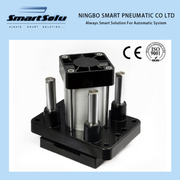
What is the difference between air cushion cylinder and hydraulic cushion cylinder?
Oct 11, 2019
For the cylinder with higher speed near the end of stroke, the piston will impact the end cap with great force (energy), causing vibration and damage to the machine parts. If no measures are taken, the life of the cylinder will be shortened rapidly and the cost of equipment will be increased. So buffer measures need to be taken.
The difference between air cushion cylinder and hydraulic cushion cylinder is that the difference between them can be compared by the advantages of the two cylinders.
Advantages and characteristics of air cushion cylinder:
When the cushioning stroke is small, the cushioning force will be larger, and there will be no rebound phenomenon when the adjustment is reasonable. However, due to the small volume of the cushioning chamber and the strength limitation, the maximum pressure of the cushioning chamber should not be too large, and the maximum cushioning force will not be too large, so the air cushioning cylinder can only absorb less energy.
Advantages of Hydraulic Buffer Cylinder:
It can make the cushioning force reach the maximum in a very short journey. If the design is reasonable, the cushioning force can be kept basically unchanged in the range of the journey. Because the hydraulic buffer works under high pressure, the small diameter buffer can get larger cushioning force, so it can absorb large impact energy. Since all the energy absorbed is converted into heat energy, there will be no rebound.