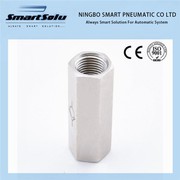
Difference between throttle valve and speed regulating valve
May 31, 2021
1. Throttle valve is to regulate and control the size of the opening in the valve, which directly limits the flow of fluid to achieve the purpose of throttling. Because it is forced throttling, there will be a large pressure difference before and after throttling, and the pressure loss of controlled fluid is relatively large, that is to say, the pressure after throttling will decrease. 2. On the basis of the throttling principle of the throttle valve, a set of pressure compensation device is added to the internal structure of the valve to improve the phenomenon of large pressure loss after throttling, so that the pressure of the fluid after throttling is basically equal to that before throttling, and reduce the heat generation of the fluid. The speed regulating valve is generally divided into two-way speed regulating valve and three-way speed regulating valve. The two-way speed regulating valve is composed of a constant differential pressure reducing valve and a throttle valve in series. The three-way speed regulating valve is composed of a constant differential relief valve and a throttle valve in parallel, but they all have one common characteristic: that is, the pressure difference between the inlet and outlet of the throttle valve is basically constant, In this way, the flow through the throttle valve is only related to the valve opening a, and has nothing to do with the load pressure fluctuation.
Speed control valve also seems to be called compensation valve
The throttle valve is like a faucet. If you screw it too much, the water will flow more. But if the faucet turns the same number of times, the pressure in the pipe is high, the water will flow more, and if the pressure is low, the water will flow less. But the speed control valve is not no matter how high the pressure in the pipe (relative) when the faucet turns the same number of times, the water flow is the same.

2 as shown in the figure, the speed regulating valve is a pressure compensated throttle valve. It has a constant differential pressure reducing valve and a throttle valve in series. The pressure P2 and P3 at the front and rear of the throttle valve are respectively led to the right and left ends of the valve core. When the load pressure P3 increases, the liquid pressure at the left end of the pressure reducing valve core increases, the valve core moves to the right, the pressure reducing port increases, the pressure drop decreases, so that P2 also increases, and the pressure difference of the pressure of the flow valve (P2-P3) remains unchanged; vice versa. This is that the flow of the governor valve is constant (not affected by the load).