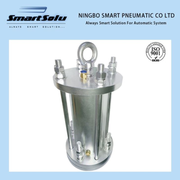
New information of pneumatic actuator -- basic knowledge (structure, working principle) of rotating cylinder
Mar 07, 2020
A cylindrical metal part that guides the piston to and fro in a straight line in the cylinder. In the engine cylinder, air transforms heat energy into mechanical energy through expansion; in the compressor cylinder, air receives piston compression to increase the pressure. The casing of a turbine, rotary piston engine, etc., is often referred to as a "cylinder.". Application fields of cylinder: printing (tension control), semiconductor (spot welding machine, chip grinding), automatic control, robot, etc.
The rotating cylinder is composed of cylinder barrel, end cover, piston, piston rod, bolt, locating pin, valve core of valve seat, valve body, circlip and seal for shaft, etc.
Working principle of rotating cylinder:
(1) Step 1, reset. The air pressure (0.1-0.8MPa) is introduced from air port B, and the air is discharged from air port a. the piston and piston rod return backward. When the piston touches the right end of the cylinder block, it stops. The piston rod end is at point a, which is the reset state.
(2) Step two, work. The air pressure (0.1-0.8MPa) is introduced from air port a, and the air is discharged from air port B at the same time. The piston rod and piston extend forward. When the piston touches the front cover, it stops moving. At this time, the piston rod end is at point B, and the distance between AB is the stroke s of the piston. This state is the working state of the rotating cylinder.
(3) Repeat the steps so that the cylinder body rotates and the piston rod moves back and forth.